
Editorial status: clinical_review
The bird-dog is a hands-and-knees exercise for practising trunk control while one leg and, if appropriate, the opposite arm move. It can be scaled from a foot slide to a full reach and may form part of a wider programme, but it is not a cure or a uniquely superior exercise for back pain.
What this exercise is for
The exercise challenges the trunk and pelvis to remain reasonably steady while the limbs move. AAOS identifies the back extensors, erector spinae and gluteal muscles among the main muscles involved.
It is sometimes called one of the ‘McGill Big Three’. Evidence on the three-exercise programme is limited and does not show that bird-dog is universally better than other suitable exercise.
Quick facts
- Main Goal
- Trunk control and endurance during limb movement
- Position
- Hands and knees
- Equipment
- Exercise mat; optional knee padding
- Starting Level
- Scalable from foot slide to opposite-limb reach
- Time
- About 4 to 8 minutes
When it may be considered
- When practising a steady trunk during arm and leg movement fits your goals.
- When the hands-and-knees position is comfortable enough to move and breathe normally.
- As one option in a programme chosen around your needs, preferences and capabilities.
Get assessed before trying it if
- You have recent shoulder, wrist, hip or knee injury, recent abdominal or spinal surgery, or a known fragility fracture.
- Back pain followed significant trauma, is severe or rapidly worsening, or is accompanied by fever, feeling unwell, unexplained weight loss or a history of cancer.
- You cannot tolerate weight through the hands or knees even with a supported variation.
- You are unsure whether this movement fits your symptoms or recovery stage.
How to do it
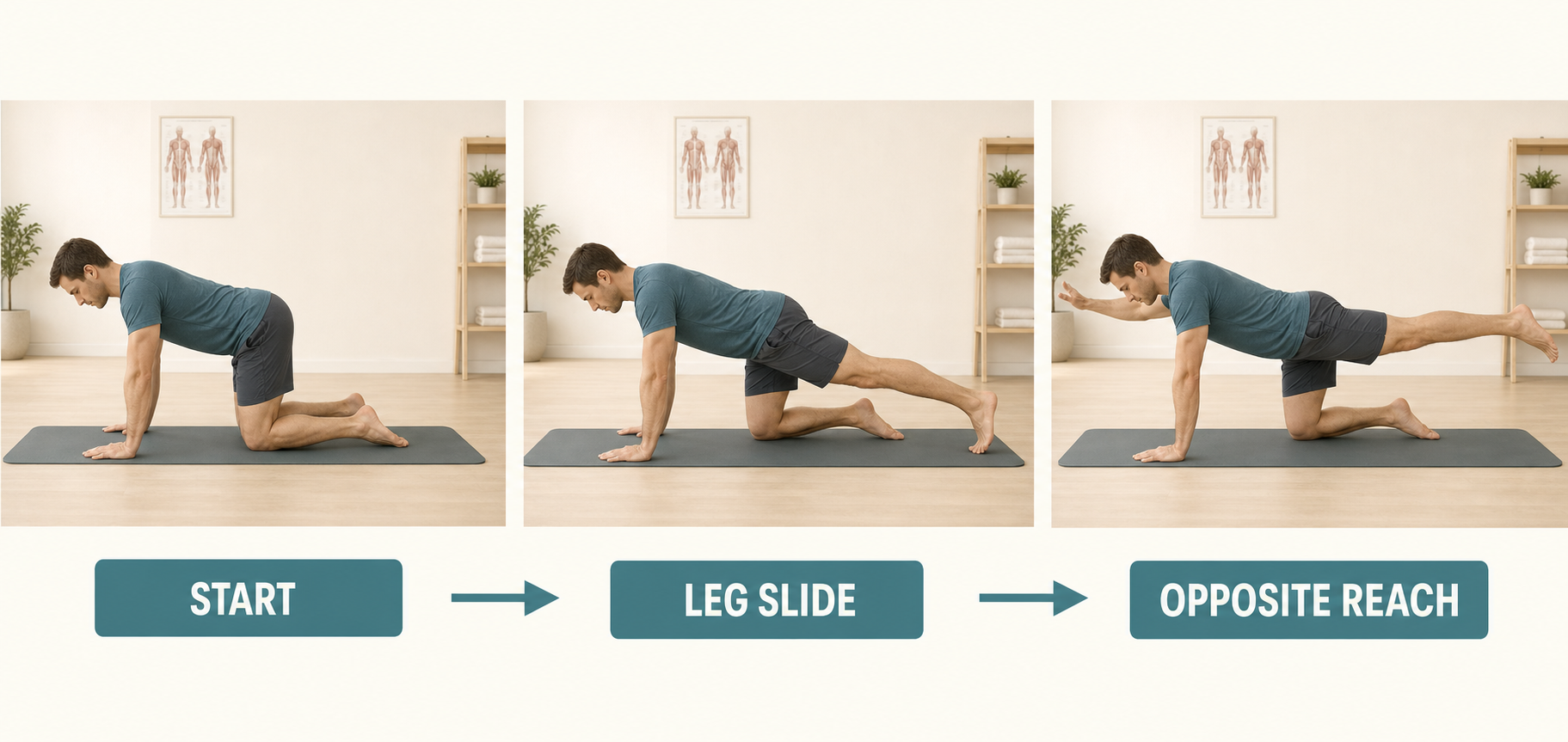
- Start on hands and knees, with hands roughly below shoulders and knees below hips. Use knee padding if needed.
- Find a comfortable middle position for the back. Gently tense the trunk while continuing to breathe.
- Slide one foot backwards along the floor. If the trunk remains comfortable and steady, lift the leg only to about trunk height.
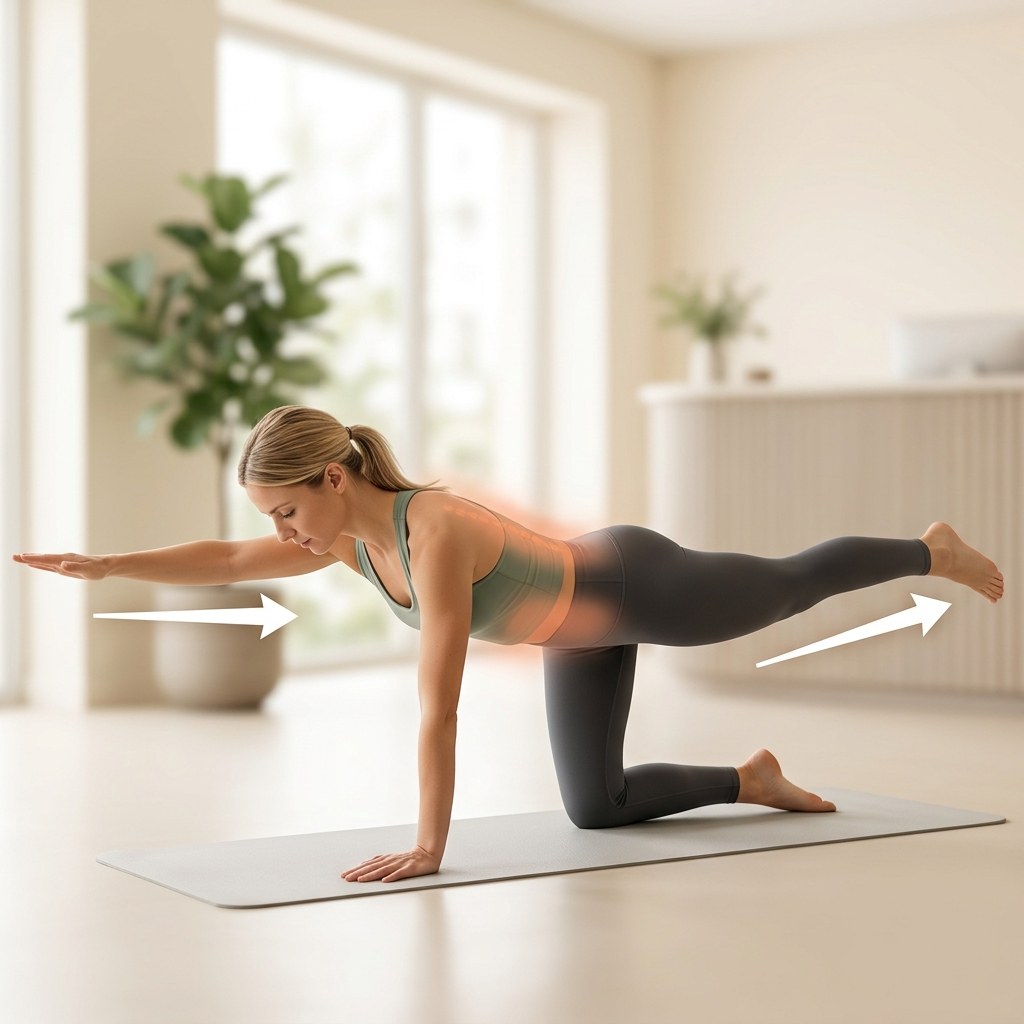
- If that is controlled, reach the opposite arm forwards. Think about reaching long rather than lifting high.
- Keep the pelvis reasonably level, breathe during the brief hold, then return the hand and knee slowly. Repeat on the other side if appropriate.
Dosage
- Starting Point: 1 set of 2 to 4 controlled repetitions per side
- Hold: About 3 to 5 seconds while breathing
- Frequency: Try on 2 or 3 non-consecutive days initially
- Progression Rule: Increase only one variable at a time: range, hold, repetitions or resistance
- Evidence Note: This is a cautious editorial starting point, not a proven optimal dose
How to judge your response
Expected response
- Moderate muscular effort around the abdomen, back, shoulders or buttocks.
- Mild fatigue or short-lived soreness after an unfamiliar session.
Reduce or simplify
- Shorten the reach or move only one limb if the pelvis rotates or the lower back arches.
- Use a wall-supported version if the wrists, shoulders or knees cannot tolerate the floor position.
Stop and seek advice
- Stop for sharp or spreading pain, or new tingling, numbness or weakness.
- Seek clinical advice if symptoms remain clearly worse or repeatedly flare with the exercise.
Seek urgent assessment
- Call 999 or go to A&E for new loss of feeling around the genitals or anus, bladder or bowel changes, or pain, tingling, weakness or numbness in both legs.
Common mistakes
- Lifting the leg above trunk height and arching the lower back.
- Rotating the pelvis towards the lifted leg.
- Shrugging through the supporting shoulder.
- Holding the breath or rushing between sides.
- Adding resistance before the unloaded version is comfortable.
Make it easier
- Keep all four contact points down and practise gentle tension with breathing.
- Slide one foot back without lifting it, or lift one hand only.
- Use a standing version with both hands on a wall or stable counter.
Progress it
- Increase the reach or hold gradually while maintaining breathing.
- Add repetitions before external resistance.
- Use a light resistance band only after the standard version is consistently controlled.
Evidence and limitations
Exercise probably helps some people with chronic low back pain, although average effects are modest. NICE recommends selecting exercise around individual needs, preferences and capabilities.
Motor-control exercise has not shown superior outcomes to other forms of exercise. A small study of the ‘McGill Big Three’ programme found broadly similar improvement to conventional physiotherapy and does not establish bird-dog’s independent effect.
AAOS includes bird-dog in a broader spine-conditioning programme. Its technique and dose are examples of a programme, not proof that bird-dog or one specific dose is optimal.
Common questions
Must my arm and leg be parallel to the floor?
No. Reach only as far as you can while staying comfortable and reasonably steady. Higher is not automatically better.
What if my wrists or knees hurt?
Use padding or a wall-supported variation. Fists or handles change the hand-loading demands and may not suit everyone.
Is this one of the McGill Big Three?
Yes, but the label does not mean it is uniquely effective. It is one scalable exercise option among many.
References
- Low back pain and sciatica in over 16s: assessment and management — guideline; accessed 2026-07-12
- Exercise therapy for chronic low back pain — systematic review; accessed 2026-07-12
- Motor control exercise for chronic non-specific low-back pain — systematic review; accessed 2026-07-12
- Effects of McGill stabilization exercises and conventional physiotherapy on pain, functional disability and active back range of motion in patients with chronic non-specific low back pain — trial; accessed 2026-07-12
- Spine Conditioning Program — health system; accessed 2026-07-12
- Back pain — health system; accessed 2026-07-12
Clinical review date: pending
Educational information only. It cannot determine whether an exercise is appropriate for your individual symptoms or replace an assessment by a qualified healthcare professional.