
Editorial status: clinical_review
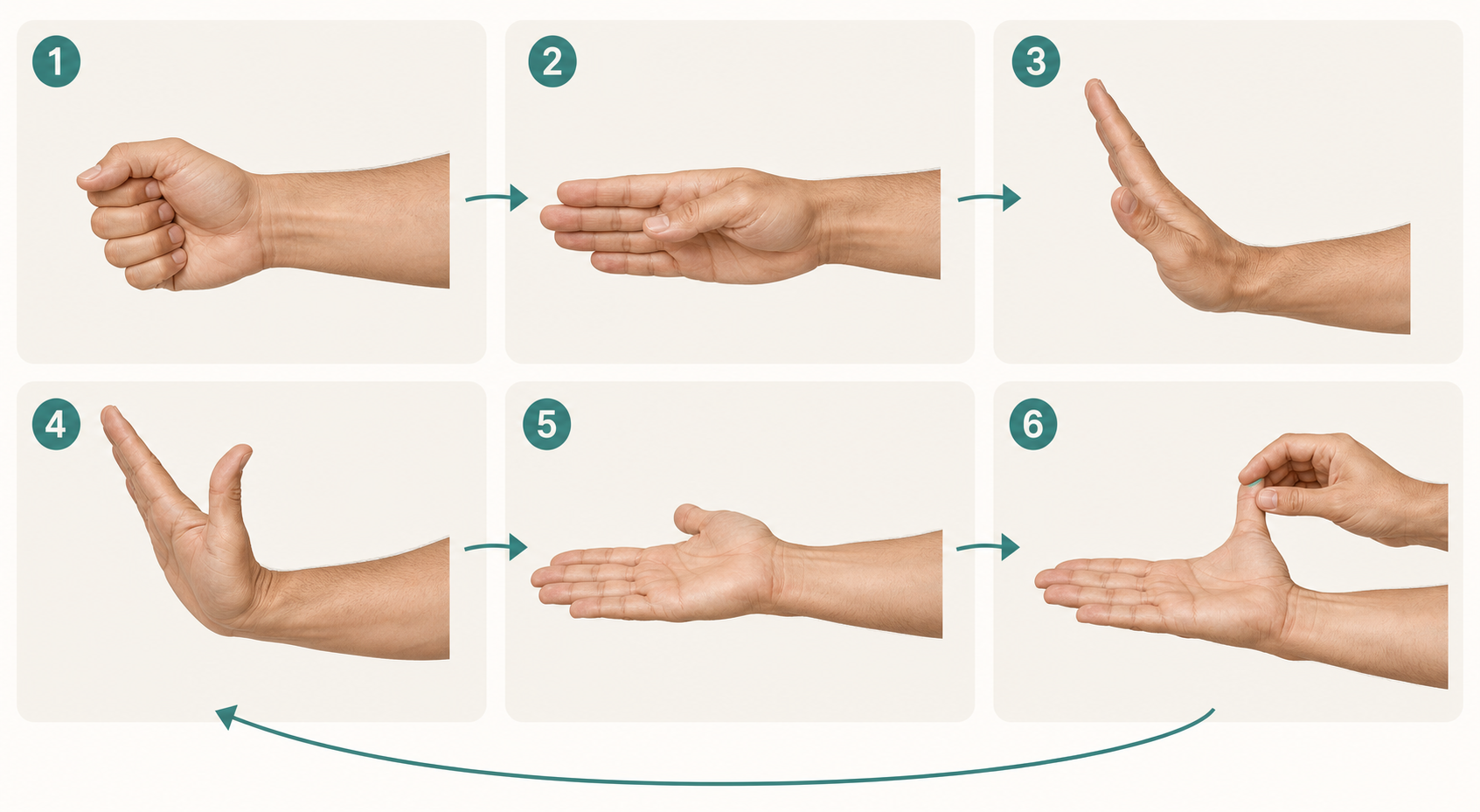
This six-position sequence moves the fingers, wrist, thumb and forearm in stages. A clinician may include it alongside other care for selected carpal tunnel symptoms, but research has not shown reliable long-term benefit and the sequence may aggravate an irritable nerve. It is not a diagnostic test, cure or replacement for assessment.
What this exercise is for
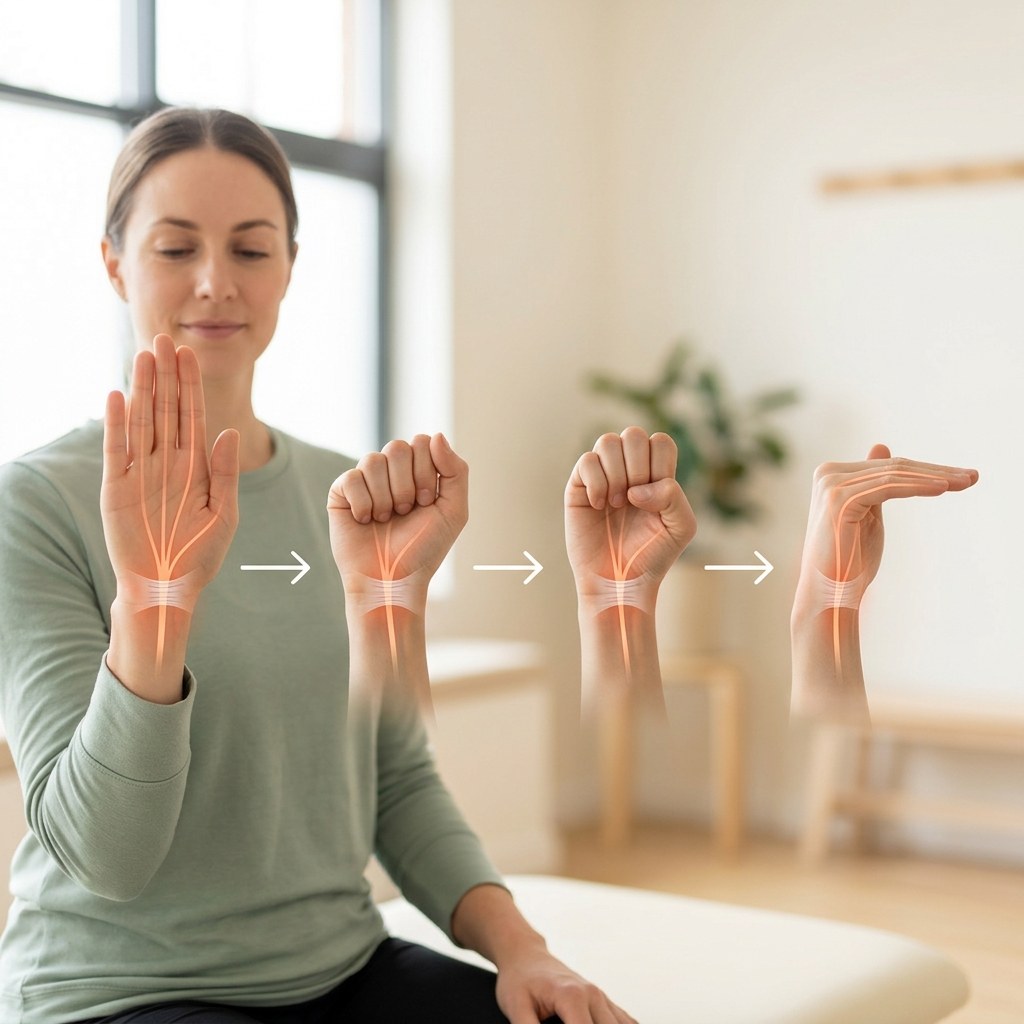
The median nerve passes through the carpal tunnel at the wrist and supplies feeling to the thumb, index finger, middle finger and part of the ring finger. Carpal tunnel symptoms can include tingling, numbness, pain and reduced hand function, often with worse symptoms at night.
This is a staged hand, wrist, thumb and forearm sequence. It is not the same as a whole-arm median nerve slider, which coordinates movement at the neck, shoulder and elbow, and it should not be turned into a forceful nerve tensioner.
The sequence is sometimes prescribed alongside care such as education, changes to aggravating activities or a night splint. It has not been shown to reverse nerve compression or replace established care.
Quick facts
- Main Goal
- Move through six gentle positions without a lasting symptom increase
- Position
- Sitting or standing with the shoulder relaxed
- Equipment
- None
- Starting Level
- A clinician-guided option for selected symptoms
- Time
- About 2 minutes
When it may be considered
- A clinician has assessed mild-to-moderate carpal tunnel symptoms and suggested this sequence as one part of a wider plan.
- Symptoms are stable enough to test a small, comfortable movement and monitor the response during and for several minutes afterwards.
- You understand that the evidence is uncertain and that gliding does not replace a splint, activity advice or other care recommended for you.
Get assessed before trying it if
- You have not been assessed and are unsure whether the symptoms come from the carpal tunnel; neck, nerve, tendon and joint problems can overlap.
- Numbness is becoming constant, symptoms are worsening or not settling, or self-care has not helped.
- Thumb or grip strength is declining, you are dropping objects, fine hand tasks are becoming unreliable, or the muscles at the thumb base appear smaller.
- Symptoms followed a significant injury or are accompanied by marked swelling, deformity or widespread arm symptoms.
How to do it
- Sit or stand comfortably with the shoulder relaxed. Keep the elbow near your side. Begin with the wrist straight and make a gentle fist, with the thumb outside the fingers.
- Straighten the fingers while keeping the wrist straight and the thumb beside the hand.
- Keep the fingers straight and gently bend the wrist backwards only as far as comfortable.
- Keep the fingers and wrist in position and move the thumb away from the palm.
- Maintain that comfortable position and turn the forearm until the palm faces upwards.
- Optional final position: use the other hand to add a very small amount of thumb movement without pulling forcefully. Release, then return through the positions comfortably. You do not need to reach this position.
Dosage
- Starting Point: Try up to 5 slow cycles, using only the comfortable positions
- Hold: Move in and out; do not force or sustain the final position
- Frequency: Once daily is a cautious trial, not a proven best dose
- Review Rule: Follow a clinician's different prescription; reduce or stop according to the response guide
- Evidence Note: Published protocols vary; research has not established an optimal dose
How to judge your response
Expected response
- No symptom increase is required. A mild pull or brief familiar tingle may occur, but it should ease when you release the position or within a few minutes of stopping.
Reduce or simplify
- Use less wrist or thumb movement, leave out the optional final position or do fewer cycles if tingling becomes stronger or begins earlier in the sequence.
- Relax the shoulder and use less effort if you find yourself lifting the shoulder, gripping or pulling.
Stop and seek advice
- Stop the session for pain, burning, increased numbness, an unfamiliar symptom or symptoms that do not settle within a few minutes.
- Seek clinical advice if the sequence repeatedly aggravates symptoms, your usual symptoms remain worse between sessions or hand function is deteriorating.
Seek urgent assessment
- Seek urgent medical help for sudden loss of hand power or feeling, inability to move the hand after an injury, major swelling or deformity, or a newly blue or grey hand.
- Call 999 for sudden arm weakness together with facial weakness or speech difficulty.
Common mistakes
- Treating each position as a strong stretch or trying to create tingling.
- Moving straight to the assisted-thumb position instead of checking the response to each stage.
- Holding the end position when symptoms are irritable rather than releasing promptly.
- Confusing this hand-and-wrist sequence with a whole-arm slider or a forceful tensioner.
- Continuing despite symptoms that become stronger, unfamiliar or slow to settle.
Make it easier
- Use only the fist-to-open-hand positions while keeping the wrist straight.
- Use a smaller amount of wrist movement and leave the thumb beside the hand.
- Stop before forearm rotation or the assisted-thumb position.
- Perform fewer cycles and discuss repeated aggravation with a clinician rather than repeatedly testing it.
Ways to adjust the sequence
- Add only one comfortable position at a time; reaching all six positions is not the goal.
- Increase the range before considering more repetitions, provided symptoms remain mild and settle promptly.
- Use a clinician's prescribed dose where it differs from this cautious starting point.
- Do not progress by pulling harder, holding longer or deliberately producing stronger tingling.
Evidence and limitations
The 2026 carpal tunnel rehabilitation guideline found conflicting evidence for neurodynamic mobilisation in mild-to-moderate carpal tunnel syndrome and made no recommendation for or against it. The guideline also noted that varied techniques and multi-part treatments make the effect of a particular glide difficult to isolate.
A Cochrane review found limited, very-low-certainty evidence across a varied group of exercise and mobilisation treatments. Its literature searches ended in January 2012, despite later publication metadata, and only two included studies measured adverse effects.
A 2023 report of a randomised trial in mild carpal tunnel syndrome found that adding tendon and nerve gliding to a night splint did not provide additional benefit over the splint alone after six weeks. The 2024 AAOS guideline also found that exercise had not improved long-term patient-reported outcomes. This does not prove that no individual can find a glide helpful; it means benefit, safety, the best technique and the best dose remain uncertain.
Common questions
Should I feel tingling?
No. Tingling is not the goal. A brief familiar tingle may occur, but release the position and stop if it becomes stronger, unfamiliar or does not settle within a few minutes.
Do I need to use all six positions?
No. Use only the comfortable stages. The assisted-thumb position is optional and should never be forced.
Is this a nerve stretch?
Treat it as a gentle movement sequence, not a sustained stretch. A stronger pull is not evidence that the exercise is working better.
Can this replace a splint or an assessment?
No. Gliding is sometimes used alongside other care. Persistent numbness, weakness, worsening symptoms or an uncertain diagnosis should be assessed.
How soon should it help?
There is no reliable response time and research has not identified who is most likely to benefit. Do not keep increasing the dose while waiting for an effect.
References
- Hand Pain and Sensory Deficits: Carpal Tunnel Syndrome: Revision 2026 — guideline; accessed 2026-07-12
- Management of Carpal Tunnel Syndrome Evidence-Based Clinical Practice Guideline — guideline; accessed 2026-07-12
- Exercise and mobilisation interventions for carpal tunnel syndrome — systematic review; accessed 2026-07-12
- Effectiveness of Tendon and Nerve Gliding Exercises in the Treatment of Patients With Mild Idiopathic Carpal Tunnel Syndrome: A Randomized Controlled Trial — trial; accessed 2026-07-12
- Therapeutic Exercise Program for Carpal Tunnel Syndrome — health system; accessed 2026-07-12
- Median Nerve Exercises — health system; accessed 2026-07-12
- Carpal tunnel syndrome — health system; accessed 2026-07-12
Clinical review date: pending
Educational information only. It cannot determine whether an exercise is appropriate for your individual symptoms or replace an assessment by a qualified healthcare professional.