
Editorial status: clinical_review
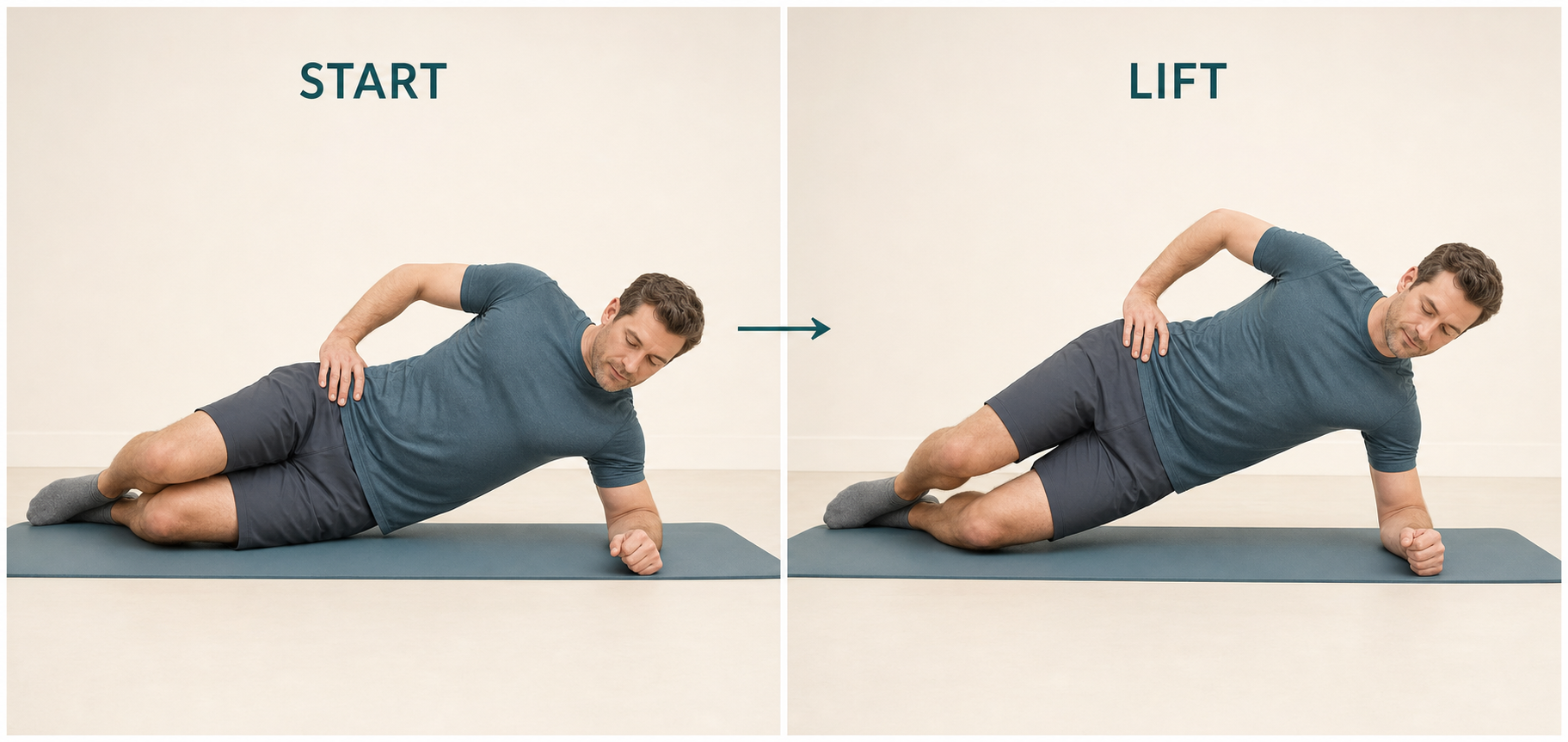
The side plank is a forearm-supported exercise for lateral trunk and shoulder control. A bent-knee version shortens the lever and may be a more accessible starting point. It can form part of an individual exercise programme, but it is not a diagnosis-specific treatment and one fixed daily dose is not suitable for everyone.
What this exercise is for
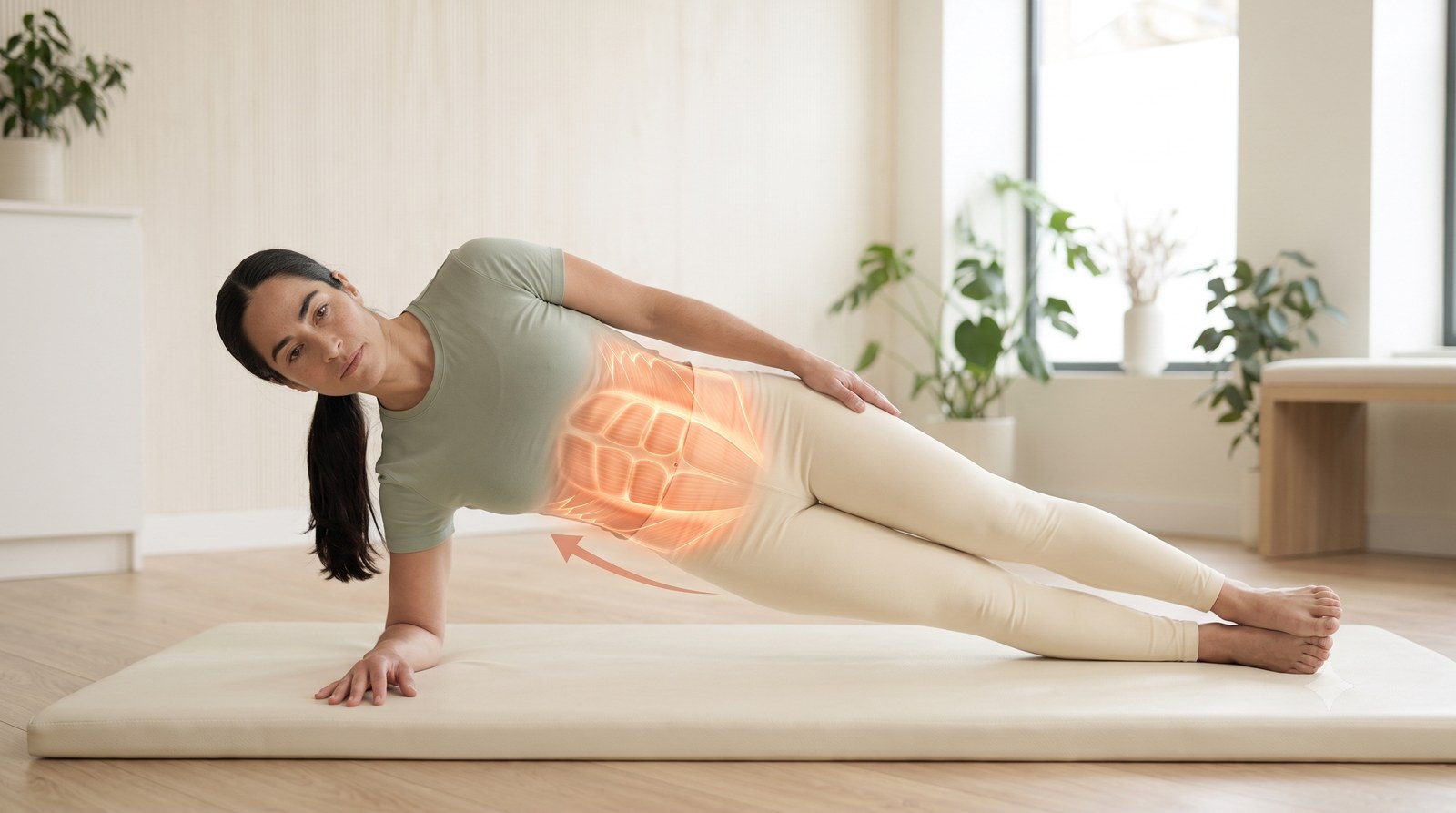
The exercise asks the muscles around the side of the trunk, hip and supporting shoulder to keep the body lifted in side-lying. The demand changes considerably with knee position, lever length and hold duration.
It is sometimes described as one of the ‘McGill Big Three’. Limited comparative research on the three-exercise programme does not show that the side plank is uniquely effective or that everyone needs to train both sides identically.
Quick facts
- Main Goal
- Lateral trunk endurance and supported shoulder control
- Position
- Side-lying on one forearm
- Equipment
- Exercise mat; optional elbow padding
- Starting Level
- Begin with bent knees or a raised support
- Time
- About 3 to 6 minutes
When it may be considered
- When lateral trunk endurance fits your strength, rehabilitation or activity goals.
- When you can tolerate side-lying and weight through the forearm without shoulder, elbow or side-hip pain.
- As one exercise option selected around your needs, preferences and capabilities.
Get assessed before trying it if
- You have shoulder pain or instability, elbow bursitis, recent rib, shoulder, hip, abdominal or spinal surgery, or a known fragility fracture.
- Back pain followed significant trauma, is severe or rapidly worsening, or is accompanied by fever, feeling unwell, unexplained weight loss or a history of cancer.
- Lying on the affected side causes marked hip pain or you cannot bear weight through the forearm comfortably.
- You are uncertain whether the exercise fits your symptoms or current recovery stage.
How to do it
- Lie on your side with both knees comfortably bent. Place the supporting elbow roughly beneath the shoulder and the forearm forwards on the floor.
- Keep the head in line with the trunk and allow the supporting shoulder to stay away from the ear.
- Gently lift the hips until the trunk forms a comfortable line from shoulder to knees. Do not force maximum height.
- Breathe normally during the brief hold, then lower with control. Turn over carefully before trying the other side if appropriate.
- For a longer-lever version, gradually straighten the legs only after the bent-knee version is comfortable and controlled.
Dosage
- Starting Point: 1 set of 2 to 4 holds on each comfortable side
- Hold: About 3 to 5 seconds while breathing
- Frequency: Try on 2 or 3 non-consecutive days initially
- Progression Rule: Increase either lever length, hold time or repetitions—one variable at a time
- Evidence Note: This is a cautious editorial starting point; the 8-to-10-second 6/4/2 daily protocol is not an established optimum
How to judge your response
Expected response
- Moderate effort around the side of the abdomen, waist, buttock and supporting shoulder.
- Mild muscle fatigue or short-lived soreness after an unfamiliar session.
Reduce or simplify
- Use a wall, raised forearm support or shorter hold if the hips sag or the shoulder shrugs.
- Use fewer repetitions or avoid the painful side if discomfort increases across the set.
Stop and seek advice
- Stop for sharp or increasing shoulder, rib, hip or back pain, or new spreading pain, tingling, numbness or weakness.
- Seek clinical advice if symptoms remain worse or repeatedly return with the exercise.
Seek urgent assessment
- Call 999 or go to A&E for new loss of feeling around the genitals or anus, bladder or bowel changes, or pain, tingling, weakness or numbness in both legs.
Common mistakes
- Placing the elbow too far from the shoulder.
- Shrugging the supporting shoulder towards the ear.
- Letting the hips sag or rolling the trunk forwards.
- Holding the breath or chasing a maximal hold.
- Progressing to straight legs before the shorter lever is comfortable.
Make it easier
- Use a wall-supported side hold.
- Place the forearm on a stable raised surface.
- Keep the knees bent and use a shorter lift or hold.
Progress it
- Lengthen the hold slightly while breathing normally.
- Move gradually from bent knees towards straighter legs.
- Add repetitions before considering complex variations such as rotation or top-leg movement.
Evidence and limitations
NICE supports individualised exercise for low back pain, and broader evidence suggests exercise can modestly help some people with chronic low back pain. It does not identify the side plank as a required or superior exercise.
Motor-control exercise generally produces similar outcomes to other exercise. A small trial of the full ‘McGill Big Three’ programme found broadly similar improvement to conventional physiotherapy, but it cannot establish the independent effect of the side plank.
AAOS includes a modified side plank in a wider conditioning programme and identifies the quadratus lumborum and oblique muscles as targets. Its protocol is an example, not evidence that one dose is optimal.
Common questions
Do I need to train both sides equally?
Not necessarily. Both sides may be included in a general programme, but symptoms, goals and clinician advice can justify different starting doses or another exercise.
Must I progress to straight legs?
No. The bent-knee or raised-support version may provide enough challenge and can remain the chosen exercise.
Should my shoulder work?
Some muscular effort is expected, but sharp pain, instability or increasing joint discomfort is a reason to reduce or stop.
References
- Low back pain and sciatica in over 16s: assessment and management — guideline; accessed 2026-07-12
- Exercise therapy for chronic low back pain — systematic review; accessed 2026-07-12
- Motor control exercise for chronic non-specific low-back pain — systematic review; accessed 2026-07-12
- Effects of McGill stabilization exercises and conventional physiotherapy on pain, functional disability and active back range of motion in patients with chronic non-specific low back pain — trial; accessed 2026-07-12
- Spine Conditioning Program — health system; accessed 2026-07-12
- Back pain — health system; accessed 2026-07-12
Clinical review date: pending
Educational information only. It cannot determine whether an exercise is appropriate for your individual symptoms or replace an assessment by a qualified healthcare professional.