
If the pelvis drops or the trunk lurches when someone stands on one leg, the issue is usually not balance in the abstract but poor frontal-plane control.
That matters in back pain linked to walking, stairs, and single-leg loading, which is why this exercise is used to train sideways control rather than just to test it.
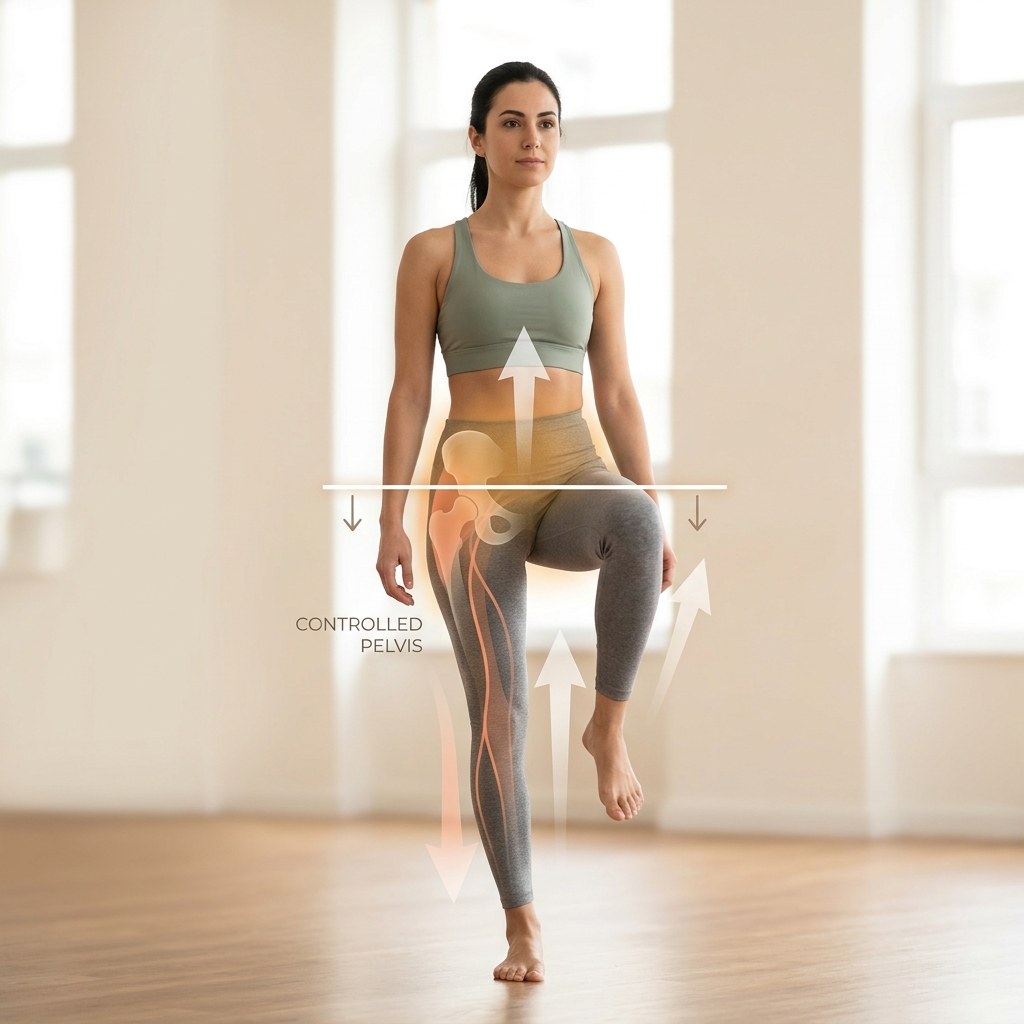
What this involves
- Keeping the pelvis and trunk stacked over one leg
- Symmetry. A big difference between your two sides matters more than either side alone
- Stand with your feet apart by about one third of the width between your hip bones
How much
Use short balance bouts on one leg and build only while the pelvis stays level.
Demo video
Further reading
- https://creativecommons.org/licenses/by/2.0/
- https://doi.org/10.1016/j.math.2015.02.005
- https://doi.org/10.1186/1471-2474-8-90
- https://doi.org/10.1186/1471-2474-9-170
- https://doi.org/10.1186/1758-2555-2-11
Safety note
If your balance is genuinely poor, practise near a wall or worktop you can touch, and tell your therapist. Falling is a bigger risk than a failed test
This is educational information to help people understand their options; it is not a substitute for a proper healthcare assessment. An accurate diagnosis is required for effective treatment. If pain or symptoms are ongoing, the worst thing you can do is nothing — seek professional counsel and assessment rather than self-treating indefinitely from a blog post.
This content is educational and does not replace individual clinical assessment.